How to Make a Gaming PC Quiet Without Losing Performance
Almost every prebuilt ships with fan settings tuned for a showroom. An hour of adjustment gets you a much quieter machine at the same frame rate.

A gaming PC that sounds like a hairdryer is usually not badly built. It is badly configured. Manufacturers set aggressive fan curves because a hot machine generates warranty claims and a loud one does not, so the safe default is to spin everything fast. You can undo most of that in an afternoon, and in nearly every case you will lose no measurable performance. Noise is worth taking seriously if the PC shares a room with you, and none of the fixes below require buying parts.
Find out what is actually making the noise
Before changing anything, identify the source. Open the side panel, start a game, and listen. Then stop each fan briefly with a finger or a pencil, one at a time, and note which one silences the sound you are chasing. Do this carefully and only for a second or two.
There are four common culprits and they sound different. Case and CPU fans produce a broad rushing noise that rises with load. Graphics card fans are higher pitched and often the loudest component in a gaming machine. A liquid cooler pump makes a constant low hum that does not change with load. Hard drives click and whir independently of everything else.
A fifth possibility is a fan that has physically worn out. A bearing on its way out produces a rattle or grinding sound that varies with orientation. Our guide to checking fan bearings and airflow covers how to confirm that, and no amount of curve tuning fixes a failing bearing.
Bigger fans moving slower beat small fans moving fast
Fan noise rises sharply with rotational speed, far faster than airflow does. Doubling RPM does not double the noise, it multiplies it. This is why a 140mm fan at 800 RPM and a 120mm fan at 1400 RPM can move similar air while sounding completely different.
The same principle explains why a 360mm liquid cooler on a mid-range processor is not overkill. Three fans sharing the same heat load each spin slower than one or two fans would have to, and the machine ends up quieter at the same temperature. You are buying silence rather than cooling capacity.
If you are replacing fans, the specification to look at is static pressure for anything mounted to a radiator or a dust filter, and airflow for open case positions. Mixing them up is a common reason a new fan disappoints.
Fan curves are the free fix
This is where most of the noise reduction comes from and it costs nothing. Every motherboard BIOS has fan control, and most support a custom curve rather than the preset silent, standard, and turbo modes.
The goal is to keep fans slow during light load, ramp gradually, and only reach full speed at temperatures you will rarely see. Idle and browsing should be near silent.
- Restart and enter the BIOS, usually with Delete or F2 during boot. Find the fan control section, often labelled Q-Fan, Smart Fan, or Fan Xpert.
- Set the lower end of the curve so fans hold a low fixed speed until the CPU reaches about 50 degrees. Many boards ship with fans already ramping at 30 degrees, which is why they never go quiet.
- Ramp gradually between 50 and 75 degrees rather than jumping. A steep step makes fans surge up and down during normal play, and changing speed is more noticeable than constant speed.
- Reach maximum speed at around 85 degrees so there is still full cooling available when it matters.
- Increase the fan step-up and step-down delay if your board offers it. This stops fans reacting to brief temperature spikes, which is the main cause of pulsing noise.
- Save, boot into Windows, run a game for twenty minutes, and check temperatures. If the CPU stays under 80 degrees, the curve is working.
Undervolting the graphics card
The graphics card is usually the loudest part of a gaming PC because it produces the most heat. Undervolting reduces the voltage the card requests at a given clock speed, which cuts power draw and therefore heat, which lets the fans slow down.
Done properly you keep almost all of your performance. A typical result is 10 to 20 percent lower power draw for a frame rate loss in the low single digits, and a card that runs several degrees cooler. Tools such as MSI Afterburner handle this for both NVIDIA and AMD cards.
The method is to lower the voltage curve slightly, test with a demanding game for half an hour, and back off if you see crashes or graphical artifacts. Work in small steps and write down what you changed. If you are buying used, be aware the previous owner may have left tuning in place, which our guide on checking for hidden overclocks explains how to detect and reset.
Case, panels, and where the PC sits
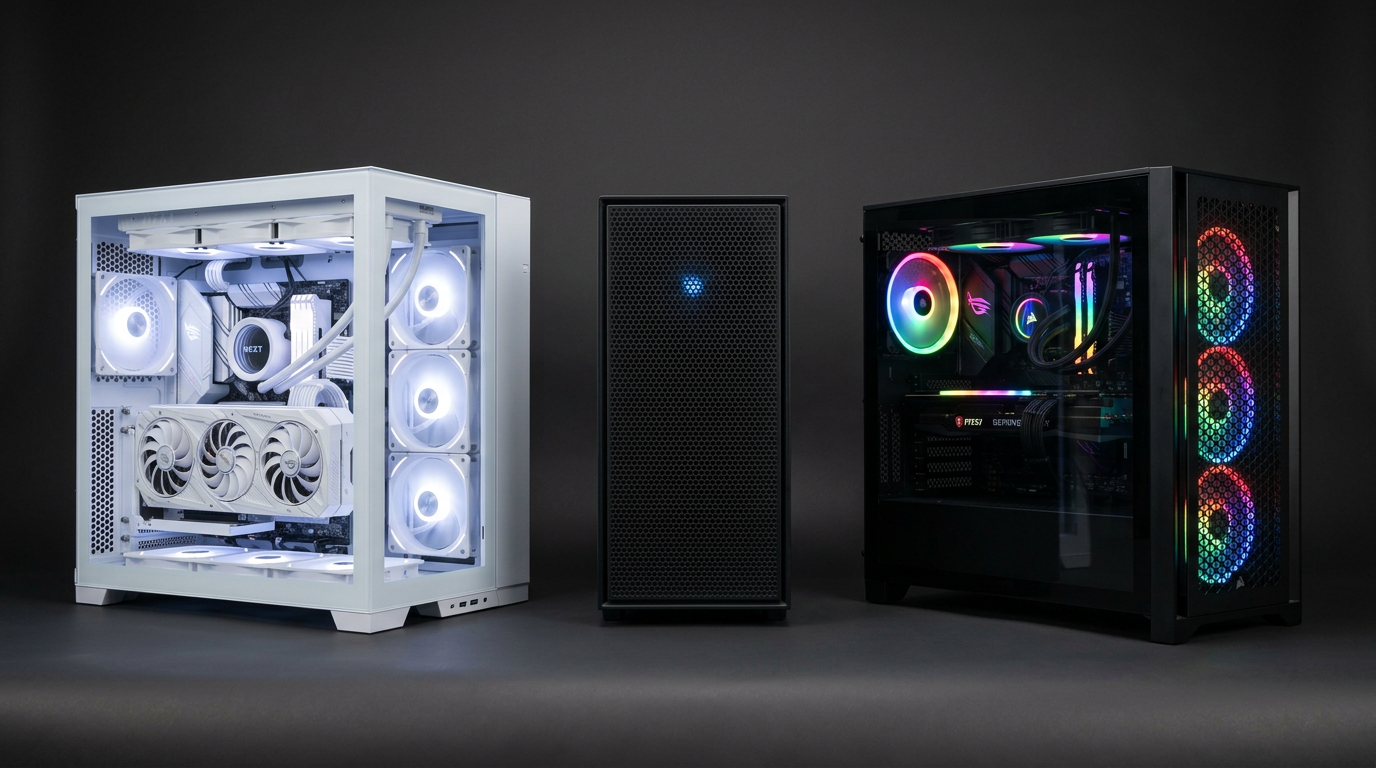
A tempered glass front panel looks good and strangles airflow, which forces every fan behind it to work harder. Mesh fronts are louder in the sense that you hear the fans directly, but the fans themselves run slower because they are not fighting a restriction. Mesh usually wins overall.
Placement matters more than people expect. A PC pushed into a desk cubby recirculates its own exhaust and reflects sound back at you. Moving it into open air on the floor, ideally on a hard surface rather than carpet, lowers both temperature and perceived noise. Carpet blocks the bottom intake that most cases use for the power supply.
Dust is the slow killer of a quiet PC. Filters clog, airflow drops, fans compensate by spinning faster, and the machine gets louder over months without anything obviously breaking. Clean filters every few months. Our notes on dust and thermal paste cover the deeper clean.
What you cannot tune away
Some noise is structural and no fan curve will help. Recognising these saves you an afternoon.
- Coil whine is an electrical noise from the graphics card or power supply, a high-pitched buzz that changes with frame rate rather than temperature. Capping your frame rate often reduces it. Nothing else will.
- Pump noise from a liquid cooler is constant. Most pumps can be set to a fixed lower speed in BIOS, but a pump with air trapped in it will gurgle until the system is tilted to move the bubble away from the pump head.
- Mechanical hard drives cannot be silenced. If a drive is holding your games, moving them to an SSD removes the noise and speeds up loading.
- A power supply with a failing fan will get louder over time and should be replaced rather than tuned, since a supply failure can take other parts with it.
Frequently asked questions
Does undervolting a GPU reduce performance?
Barely. A careful undervolt typically costs a few percent of frame rate at most, and in thermally limited cards it can actually increase sustained performance, because a cooler card holds its boost clocks for longer instead of throttling. The gains are lower power draw, lower temperature, and slower fans. Test with a demanding game for at least half an hour to confirm stability before you consider it finished.
Are more case fans quieter or louder?
More fans are usually quieter, provided you slow them down. Spreading the same cooling job across six fans at 700 RPM produces less noise than three fans at 1400 RPM moving the same air. The mistake is adding fans and leaving them all at default speed, which just adds sources. Add fans and adjust the curve together, or you will make things worse.
Is a liquid cooler quieter than an air cooler?
Not automatically. A large air cooler with a single slow fan can be quieter than a 240mm liquid cooler, and it has no pump to hum. Liquid cooling wins at higher heat loads, where a 360mm radiator lets three fans run slowly to handle wattage that would force an air cooler's fan to scream. It also adds the pump as a permanent noise source and a part that can fail.
Why does my PC get louder over time?
Dust is the usual answer. As filters and heatsink fins clog, airflow falls, temperatures rise, and the fan curve responds by spinning faster to compensate. Thermal paste also dries out over several years, raising CPU temperatures for the same workload. Cleaning filters and heatsinks restores most of it. If the noise is a rattle rather than a rush, look for a failing fan bearing instead.
Key takeaways
- Start with the BIOS fan curve. Holding fans at a low fixed speed until the CPU passes 50 degrees removes most of the noise for free.
- Undervolt the graphics card before buying quieter fans. It is the largest heat source in a gaming PC and the change is reversible.
- Ramp fans gradually and add a step delay. Changing speed is far more noticeable than a constant speed, even a slightly higher one.
Browse tested Ontario gaming PCs, or ask us about a listing before you buy.
Explore more